Science Article: Unveiling the Chinese Immune Multi-Omics Atlas (CIMA)
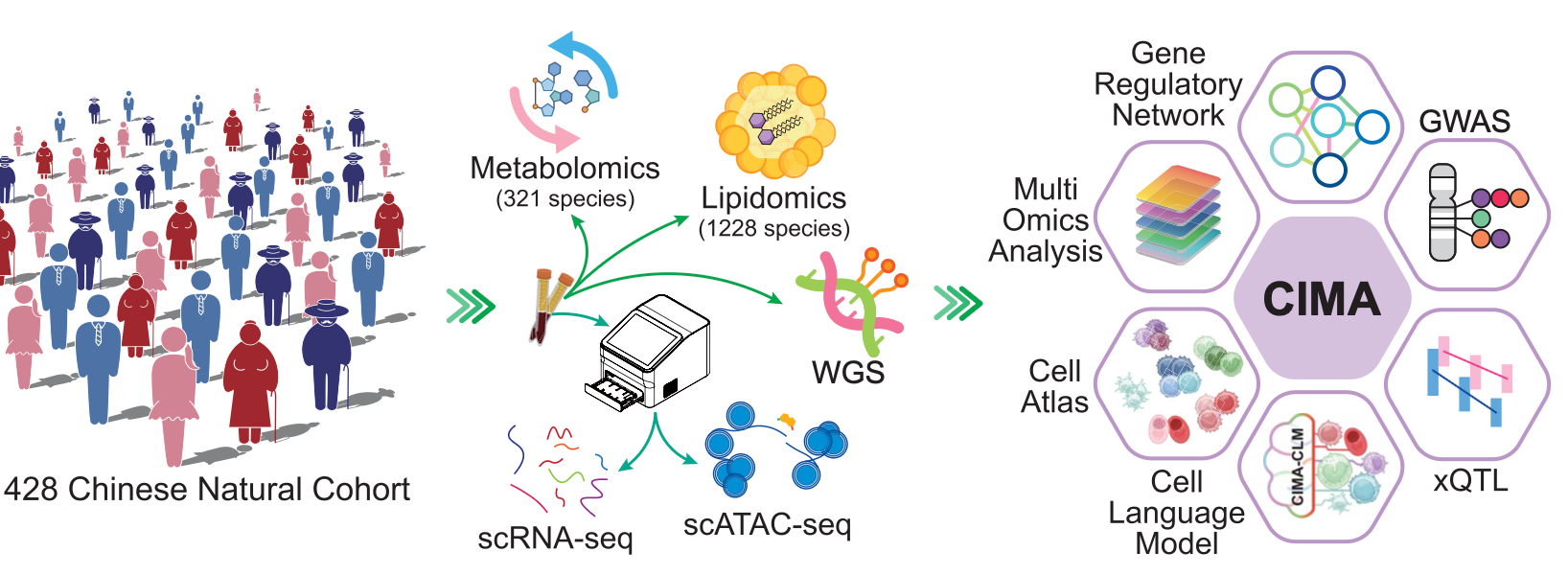
Our recent study in Science provides a comprehensive single-cell multi-omics landscape of the Chinese immune system, mapping genetic regulatory effects across over 10 million cells.
We are thrilled to announce the publication of “Chinese Immune Multi-Omics Atlas” in Science. This collaborative project presents the largest-to-date single-cell resolution genetic and epigenetic atlas of the human immune system in an East Asian population.
Background
Human immune responses are highly variable, influenced by a complex interplay of genetics, age, and environment. Mapping how non-coding genetic variants regulate gene expression and chromatin accessibility in specific cell types is crucial for understanding disease susceptibility. CIMA was built to bridge the gap in our knowledge of East Asian immunogenetics.
Key Breakthroughs
- A Massive Multi-Omics Reservoir: We profiled 6.48 million scRNA-seq and 3.76 million scATAC-seq cells from 428 healthy Chinese individuals, integrated with whole-genome sequencing (WGS), lipidomics, and metabolomics.
-
Cell-Type Specific Regulation: By mapping xQTLs at single-cell resolution, we identified thousands of genetic variants that influence gene expression (e-QTL) and chromatin accessibility (ca-QTL) in a highly cell-type-specific manner.
- Interpreting Disease Risk: CIMA provides a high-resolution lens to interpret Genome-Wide Association Study (GWAS) signals. We successfully linked 1,180 immune-related disease risk loci to their target genes across specific immune cell lineages, including systemic lupus erythematosus (SLE) and rheumatoid arthritis.
- Cross-Ancestry Insights: Comparing CIMA with European datasets highlighted both conserved and population-specific regulatory architectures, emphasizing the importance of diverse ancestral representation in human genomics.
Significance
CIMA serves as a foundational resource for the global scientific community. It offers a powerful platform to explore the functional impact of genetic variants in specific immune contexts, accelerating the discovery of drug targets and the development of personalized medicine for immune-mediated diseases.
Team & Collaboration
This study was a major collaborative effort led by BGI-Research, Xiangya Hospital, and the Chinese Academy of Sciences.
Read the full article here: https://doi.org/10.1126/science.adt3130 Explore the data: https://db.cngb.org/trueblood/cima/