Metagenomic Analysis Reveals Microbial Community Structure and Nitrogen Acquisition Strategies in the Indian Ocean
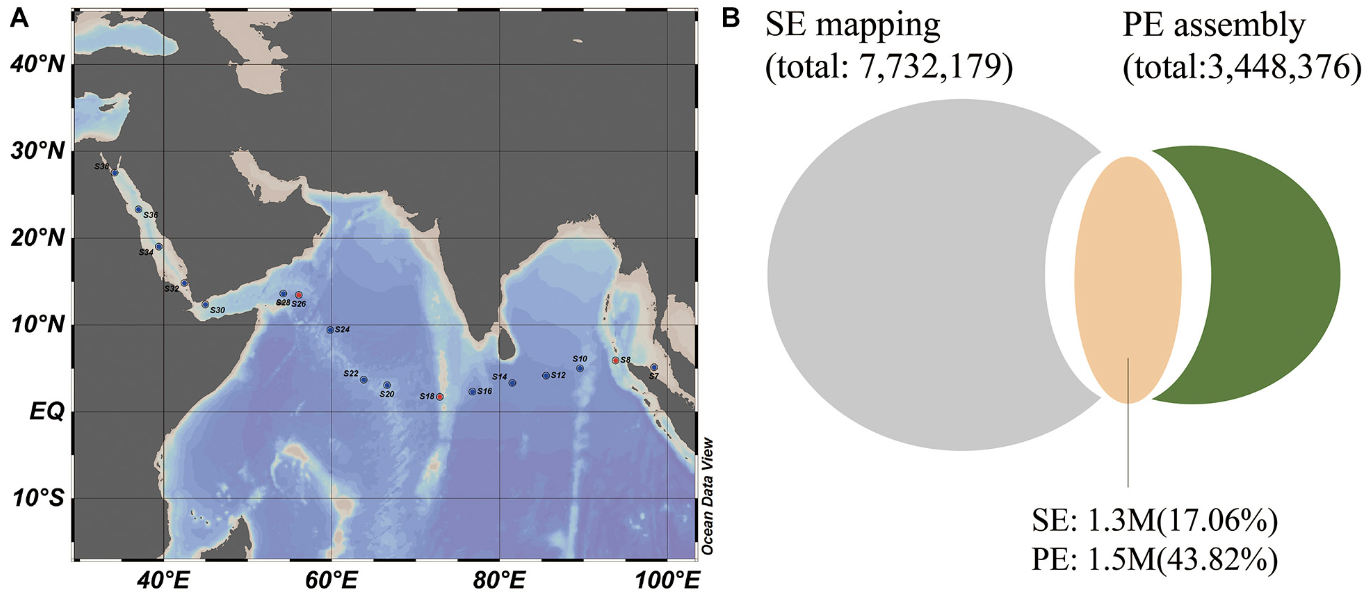
Despite being the third-largest ocean in the world, the Indian Ocean remains one of the least studied regions in terms of microbial diversity and biogeochemical functions. In our recent study published in Frontiers in Microbiology, we investigated the microbial community structure and nitrogen acquisition mechanisms in the oligotrophic surface waters of the Indian Ocean using metagenomics, providing fundamental insights into microbial adaptation and nitrogen cycling in low-nutrient environments.
Key Findings
-
Dominance of Proteobacteria and Cyanobacteria:
Our metagenomic analysis revealed that Proteobacteria and Cyanobacteria dominate the microbial communities, accounting for an average of 37.85% and 23.56% of total sequences, respectively. The genus Prochlorococcus—a key cyanobacterium in ocean ecosystems—was particularly abundant in nitrogen-limited regions. -
Nitrogen Metabolism and Adaptation:
Microbial communities rely on diverse strategies for nitrogen acquisition, given the low levels of dissolved inorganic nitrogen (DIN) in the Indian Ocean. The study identified several nitrogen assimilation pathways, including urease, glutamate dehydrogenase, and ammonia transporter genes, which facilitate nitrogen uptake for survival.
Interestingly, while Prochlorococcus utilizes ammonia and organic nitrogen sources efficiently, key genes for nitrate assimilation and nitrogen fixation were absent, highlighting its unique adaptation to oligotrophic conditions. -
Environmental Drivers of Microbial Distribution:
Using redundancy analysis (RDA), we found that temperature, phosphate, silicate, and pH were the most influential environmental factors shaping microbial distribution in the Indian Ocean, rather than inorganic nitrogen availability. These findings underscore how microbes adapt to resource limitations through functional redundancy and metabolic plasticity.
Reflections
This project is part of XinLab’s ongoing environmental genomics research and was led by Yayu Wang, who has a strong focus on environmental microbiology, particularly soil-based microbial communities. This study was conducted in collaboration with Professor Da-Zhi Wang’s team at Xiamen University, as part of our joint effort to understand microbial diversity in marine ecosystems.
I still recall the initial discussions that led to this research—building collaborations and aligning interests between our teams. The complexity of the Indian Ocean microbiome, the challenges of large-scale sequencing, and the intricacies of microbial nitrogen metabolism made this a rewarding and intellectually stimulating project. Beyond this publication, our research continues to expand into broader environmental microbiome studies, including soil and freshwater ecosystems.
The full text of this study can be accessed online at Frontiers in Microbiology.